
Consistency has nothing to do with discipline
The psychology reason you keep restarting, and the two things that actually help.

I started a 35-day yoga challenge every January for four years. My personal best was day 17.
And I am someone people call “consistent.”
If that makes you feel slightly better about yourself, good. That was intentional. Because this article is for you if you keep restarting the same habit. You know what you SHOULD be doing and but you’re still not being consistent with it. And maybe you’re quietly convinced that other people just have some kind of “built-in wiring” they were not born with and that you’re just not good at being consistent.
But let me tell you. You were not shortchanged. Your brain is just doing exactly what brains do. And once you understand that, plus the two things that actually helped me, consistency becomes a lot less personal (AND a lot more manageable).
The part nobody saw
For years, people have told me I am ✨naturally✨ good with consistency. I get why they think that. I show up for things, I post regularly, I follow through.
But that’s just what they see.
What they don’t see (just one example out of many): Every single January for the last four years, I started a 30-day yoga challenge. Alone, at home, no audience, no accountability. And every single time, I made it to day 17 at most.
Day 17. Out of 35. Four years straight.
But the part that upset me the most is not that I quit. It’s that I could not explain why. I liked the yoga. I was actually enjoying it… and I still stopped. Which, when you are someone who has been told you are good at sticking to things, creates this strange guilt spiral. I am supposed to be the consistent one. Why can I not even finish this?
It took me a while to understand what was actually happening. And I want to be clear before we go further: the yoga was just the smallest version of this pattern. The REAL places where consistency matters are the ones that shape your actual life. Holding relationships over time. Eating in a way that makes you feel good, not just this week but this year. Getting outside regularly. Being genuinely good at your job over months and years, not just when you feel inspired. Those things compound slowly and quietly, and the gap between the person who stays consistent with them and the person who keeps restarting is… enormous.
So yes, this is bigger than a yoga mat. ;)
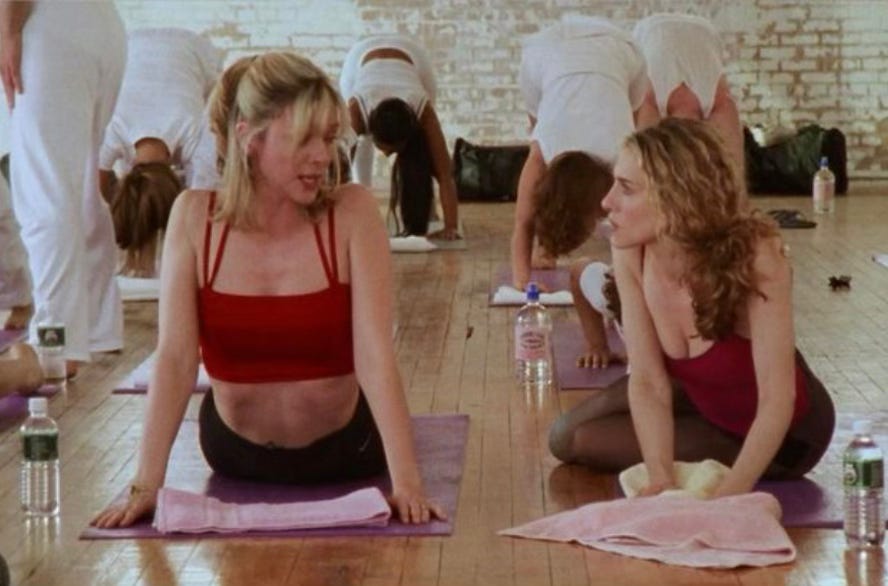
Your brain is not broken. It’s just doing its JOB.
There’s a well-documented pattern in psychology where humans consistently choose short-term rewards over long-term ones. The brain is literally wired that way. Immediate feels safe.
Future feels abstract.
And your brain will always, without asking you first, prioritise what feels good NOW.
Consistency is almost always a long-term game. The gym results, the relationship that stays close because you kept showing up, the newsletter that slowly grows, the career that becomes something real. None of those happen fast. And your brain, left to its own devices, will find a thousand reasons to stop before they do.
The people you look at and think “they just have more willpower than me” have figured out how to work WITH that wiring. They did not get a different brain. They built different systems.
The first thing that changed everything: a film, not a number.
When I started the yoga challenge, my goal “getting to day 30”. While that seems to be the goal for the challenge, it was completely useless for my motivation when it’s cold and you are tired… and Netflix exists.
The thing that actually works, in a very specific psychological way, is a specific moment and the feeling attached to it.. A scene so vivid and detailed that your brain can almost step inside it. Your brain responds to specificity. Vague goals stay in your head as words. A real scene it can almost feel becomes something it wants to experience and move toward.
And that’s what pulls you forward. Not the goal itself, but the feeling you’re chasing.
So when I think about my long-term goal of having a second home abroad, I don’t picture the words “second home abroad.” I picture a scene. It looks something like this:
My film looks like this. I’m standing on a terrace overlooking the ocean, still in my pyjamas, holding a coffee. The sun is just coming up and I can feel it on my skin, warm but not hot yet. I smell the salt air and the coffee at the same time. I can hear the waves and some birds. My family is inside, about to wake up. I’m not rushing anywhere.
That’s it. That’s the image I come back to when I need a reason to keep going. Not “I want freedom” or “I want a house abroad.” Those are just words. The terrace is something I can actually feel.
Try this with whatever you are working toward. A second home, your own music released, relationship that actually feels easy. Do not just name the goal. Put yourself inside it with enough sensory detail that your brain stops filing it under “abstract future thing” and starts treating it like a real destination. It makes being consistent a lot easier.
The second thing: a system that works even when you don’t feel like it.
Motivation is a fluctuating feeling, not a stable state. And building your consistency around it is like building a house on sand.
The yoga challenge failed because I was relying on feeling motivated every evening. Some evenings I did. Some evenings I didn’t. And on the evenings I didn’t, I told myself I would do it tomorrow. You know how that ends.
Then I remembered the tips I learned from reading the book “Atomic Habits”: attach the habit to something that already happens. Not “I will do the yoga challenge sometime in the evening.” But “I will do it before dinner. Every day. Before I sit down to eat.” That specificity removes the decision. And removing the decision removes the moment where motivation gets a vote.
Building a system doesn’t have to look the same for everyone. The best system is simply the one you’ll actually stick to.
Maybe that means leaving your yoga mat and workout clothes out where you can see them. Maybe it’s setting up a recurring calendar reminder that pops up at the same time every day. Or maybe it’s making a deal with yourself that you only have to do two minutes. Once you’ve started, continuing usually feels much easier.
The point is to build an environment that makes the right choice feel like the easiest one. Figure out what works for you.
Just make sure you build your system BEFORE you need the motivation. Because the moment you need it is exactly the moment it will not show up.
Bonus tip
If you want to do something consistently and it only takes a few minutes, use micro moments.
What do I mean by that?
Last year, I downloaded a language-learning app. Every lesson takes about five minutes, which is something almost everyone can fit into their day. The hard part isn’t finding five minutes. It’s remembering to use them.
What worked really well for me was using those tiny pockets of spare time that would otherwise go to waste. Waiting for the bus, waiting for the pasta to cook or standing in line at the supermarket.
It takes a little practice, but once you start associating these moments with your new habit instead of automatically opening Instagram or TikTok, they become the perfect trigger. Before you know it, those five-minute moments start adding up.
The thing to take with you
Nobody is born consistent. Some people have built better systems and clearer visions than others, and from the outside that looks like a personality trait you either have or not.
If you are struggling with consistency on something right now, two questions are worth sitting with.
Do you have a real scene in your head, something sensory and specific, of what you are actually working toward?
And does your system work on a day when you have zero motivation, or does it rely on you feeling ready?
If the answer to either is no, that’s where to start. Not with more discipline but with a better setup that allows consistency to feel easier.
Tell me in the comments: what’s the habit or goal you keep restarting? And what has actually helped, even a little? I read every comment!
Talk soon,
Lia
Never miss a post again!
Thanks for this! Good time for me to see it--I'm a little over two weeks into a major nutrition/food habits overhaul, and you've prompted me to envision a specific outcome scene :)
I consistently utilise that idle-time you write of~ I chip away at chores, stretching, time with the dogs, taking in the garden and birdsong ...
“What’s the habit or goal you keep restarting?
Washing up as I go along >_<
And what has actually helped, even a little?”
Purchase of a magic cupboard which snugs perfect onto the end of the sink; I put in the little things with some bicarb soda and in 30mins a community of elves have cleaned some dishes, cutlery, and cups.
For the other items~ eating earlier in the day so it's not 'one more task' in the evening, and the hand rinsing can also include a hand washing now